

In CSI's experience, most leaks in Florida condominiums start at a joint between two materials, such as a door threshold and the balcony slab. A sliding glass door brings several of those joints together at the bottom of a large opening. When a unit has water on the floor inside a balcony door, the question for the board is which joint is letting it in. For the overall investigation process, see CSI's guide to water intrusion investigation in Florida buildings.
How a Sliding Door Is Meant to Handle Water
A sliding door is not a sealed box. The operating panel rolls in a track, and one manufacturer's care guide states that it is normal for water to build up on the sill or the outside track. The door is designed to send that water back outside through weep holes, the small openings along the bottom of the sill frame that let trapped water escape to the exterior.
What keeps the collected water off the floor is the raised interior leg of the sill, sometimes called a back dam. Coastal buildings in Florida take wind-driven rain on every elevation during tropical storms and summer thunderstorms, and that wind pushes water against the back dam. A published engineering brief on windstorm leakage notes that one inch of back dam height can resist water penetration up to a pressure of about 5.2 pounds per square foot, and that sliding products relying on a back dam are typically more susceptible to leakage under severe wind than out-swinging or fixed products.
An AAMA white paper on storm-driven rain explains that many windows and doors outside the architectural performance class are tested for water penetration resistance at 15 percent of their design pressure, up to a maximum of 12 pounds per square foot in the United States, and that extraordinary storm conditions can exceed a product's rating. A leak that appears only in the strongest storms may reflect that limit, while a leak in ordinary rain is more likely to involve one of the entry points below.
Common Entry Points
The Sill and Threshold
The threshold is where the door frame sits on the balcony slab. Published guidance on door leaks calls for thresholds to be set in multiple continuous beads of sealant, with fastener holes filled. When that bedding is missing or deteriorated, water in the track or on the balcony can pass under the frame instead of draining out through the weep holes.
Sill Pans
The U.S. Department of Energy's Building America Solution Center describes pan flashing, or a sill pan, as an element installed at the sills of windows and doors to collect water that leaks through or around the opening and direct it back to the exterior. Whether a door has a pan, and whether it drains to the outside, usually cannot be confirmed without removing the door or making a small inspection opening.
Track Drainage and Weep Holes
Weep holes only work when they are open. The same care guide recommends periodically checking that weep holes are clear of dirt and debris, and the AAMA paper lists clogged drainage or weep holes among the conditions that can contribute to leaks during storm-driven rain. A track that cannot drain holds water against the back dam for longer.
Frame Corners and Interlocks
Frame corners, where the sill meets the side jambs, are joints within the frame itself, tested separately from the perimeter so the report can say whether water enters through the door or around it. Where the two panels meet, the interlocking stiles hook together to reduce air infiltration, and weatherstripping along the panel edges resists air and water infiltration through the gaps. Worn or missing weatherstripping gives wind-driven rain a path inside, and the same care guide advises replacing damaged weatherstrip promptly.
The Frame-to-Wall Perimeter
The joint between the door frame and the wall depends on sealant and on flashing behind the finish. The AAMA paper notes that a product may leak if it is not correctly flashed and sealed in accordance with the manufacturer's instructions. Salt air shortens the life of sealants, gaskets, and metal flashing.
Balcony Slope and Water at the Threshold
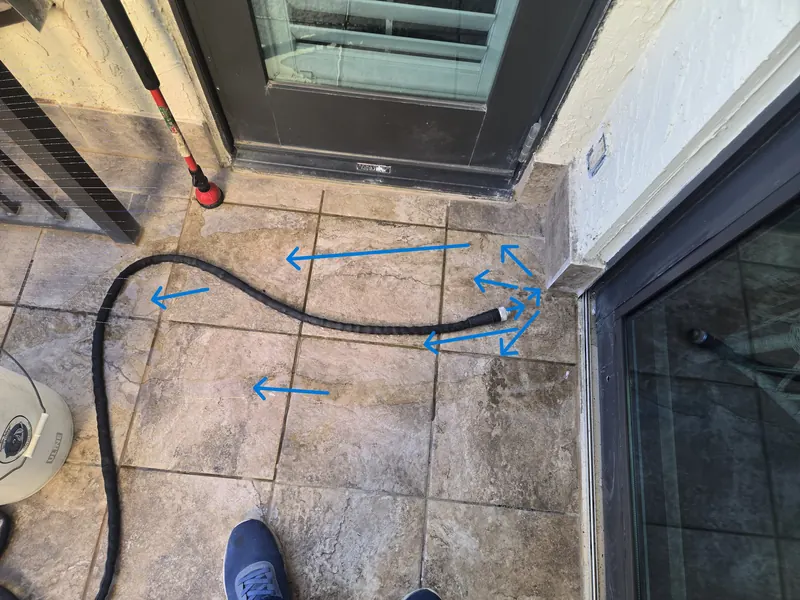
Published balcony waterproofing guidance recommends sloping the balcony to drain and describes the step down at the door threshold as especially important to prevent water infiltration. A balcony that is flat or pitched toward the unit can hold water against the threshold during a storm, adding to what the sill and its seals must hold back.
How CSI Isolates the Source
Because a sliding door has several possible entry points within a few feet of each other, the test is built to separate them.
- Leak history review. The engineer reviews where and when the leaks appear, the storms and wind directions involved, and prior repairs, then forms a working theory about the likely sources.
- Sill dam testing. A temporary dam is built around the threshold and filled with water. This separates water entering through the sill or threshold below from water entering through the joints above, which spraying alone cannot do.
- Nozzle testing. A spray nozzle fitted with a pressure gauge delivers a consistent stream of water to one joint at a time, starting low and working upward with adjacent areas masked off. The testing is based on AAMA 501.2, which defines the nozzle and gauge setup and was written for storefronts, curtain walls, and sloped glazing, and on AAMA 511, which gives guidance on adapting existing field test methods for leak investigations at windows and doors, including operable units.
- Confirmation. Moisture meters, infrared imaging, and, when needed, a small inspection opening confirm the path water takes after it enters.
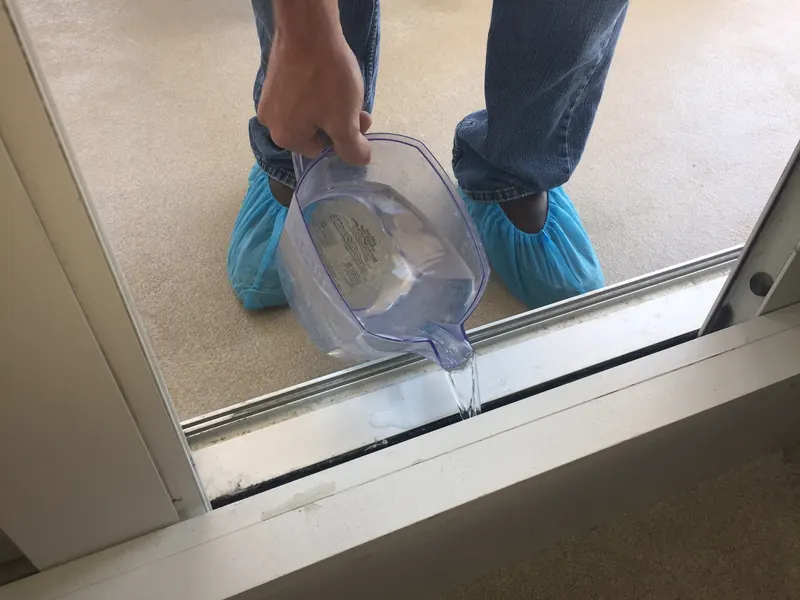
CSI's water testing team works under the direction of a licensed professional engineer, who is responsible for the conclusions in the report. What residents can expect is covered in what to expect during a condo water test, and the full approach is described on the water intrusion testing page.
Water can travel inside a wall before it appears, so a wet floor near a balcony door is not always a door leak. The differences between plumbing leak detection, infrared scans, and water testing are explained in water testing, leak detection and infrared: what each one does.
What Repairs Generally Look Like
The repair follows from what the testing shows. Depending on the source, recommendations may include:
- Cleaning the track and clearing the weep holes.
- Replacing worn or damaged weatherstripping at the panels and the interlock.
- Resealing the threshold, the frame corners, or the frame-to-wall perimeter joint.
- Removing the door to install or correct a sill pan and the flashing around the opening.
- Correcting the balcony slope or waterproofing at the threshold.
- Replacing the door assembly when the frame or its drainage cannot be restored.
A leak that is not traced to its source tends to be repaired at the stain rather than at the point of entry, which is why the testing comes first. Whether the owner or the association is responsible for a particular door depends on the declaration of condominium.
After repairs, the same tests can be repeated to confirm the repaired element does not leak under the same test conditions. CSI can prepare repair specifications for bidding, and its building envelope consulting work includes construction oversight. Under section 718.112(2)(g), Florida Statutes, the structural integrity reserve study required for condominium buildings three habitable stories or higher must include windows and exterior doors, and waterproofing and exterior painting. Water testing is not required for the study, but test results give the engineer direct evidence of how those components are performing.
For a sliding door leak that keeps coming back, see the water intrusion testing page or call CSI at (904) 261-8703.
Frequently Asked Questions
Is it normal for water to collect in a sliding door track?
Yes. A sliding door is designed to collect some water in the sill track and drain it to the exterior through weep holes, and one manufacturer's care guide notes that it is normal for water to build up on the sill or the outside track. Water on the interior floor is not part of that design.
Why does a sliding door leak only during strong storms?
Sliding doors rely on a raised interior sill leg, or back dam, to hold back water in the track, and wind pushes water against it. Engineering guidance notes that one inch of back dam height resists water penetration up to about 5.2 pounds per square foot, and an AAMA white paper notes that extraordinary storm conditions can exceed a product's rating for water penetration.
What is a sill pan?
A sill pan is a flashing installed under the sill of a window or door. It collects water that leaks through or around the opening and directs it back to the exterior. Whether a door has one, and whether it drains, usually cannot be confirmed without removing the door or making a small inspection opening.
How does CSI find where a sliding glass door is leaking?
After reviewing the leak history, CSI tests one element at a time. A sill dam test floods the threshold on its own, and nozzle testing applies water to one joint at a time, starting low and working upward with adjacent areas masked off. Moisture meters, infrared imaging, and, when needed, a small inspection opening confirm the water path.
Will replacing the sliding door stop the leak?
Not necessarily. Testing shows whether water is entering through the door, around it at the perimeter, or at the threshold and balcony below it. The repair should address the element the testing shows is failing, which may or may not be the door itself.
Have a Leak That Keeps Coming Back?
CSI's engineer-led water testing finds where water is entering windows, doors, walls, and balconies, and documents the repair it needs. CSI serves Northeast Florida, coastal Georgia, and Hilton Head, South Carolina.
See How CSI Runs Water TestingSources
- AAMA SER-1-18, Storm-Driven Rain Penetration of Windows, Skylights and Doors White Paper (AAMA, updated June 4, 2018; hosted by FGIA)
- Water Resistance Limitations of Fenestrations Under Severe Windstorm Conditions, Simpson Gumpertz & Heger topic brief, November 7, 2023
- Fully Flashed Window and Door Openings, U.S. Department of Energy Building America Solution Center
- Care and Maintenance, Milgard Windows and Doors
- Window Glossary (sill, weep hole, weatherstrip), Atrium Windows and Doors
- Glossary of Terms (interlock), Sierra Pacific Windows
- Understanding Why Doors Leak, The Construction Specifier, May 2013
- Ensuring Balcony Durability: Waterproofing Details That Stand the Test of Time, The Construction Specifier, November 2013
- 2026 Florida Statutes, Section 718.112, Bylaws (Florida Senate)
This article is general information. It is not legal advice, and it is not an engineering assessment of any specific building.