

When owners report leaks at windows, sliding glass doors, or walls, the association may hire an engineer to run a water test. The purpose is to reproduce a reported leak under controlled conditions so the source can be identified and documented. The stain inside a unit rarely marks the point of entry.
Most water tests involve occupied units. This article explains what owners and managers can expect, from the first notice to the final report. For the engineering background on how leaks are traced, see CSI's guide to water intrusion investigation in Florida buildings. For how CSI runs the testing itself, see the water intrusion testing service page.
Why the Test Needs Access to Your Unit
A water test applies water to one window, door, wall, or balcony component at a time while an observer watches the interior. When water appears inside, the test has located a point of entry. Someone must be inside each unit during its test, because the interior observer is the person who sees the water arrive. That is usually a member of CSI's water testing team, which works under the direction of a licensed professional engineer.
Water does not always travel straight down once it gets past the exterior of a building. A test may therefore involve the unit where the stain appears as well as a unit beside or above it. The engineer decides which units are needed after reviewing the leak history.
Notice and Access
The association or management company notifies owners of the test date, the units involved, and the access window. CSI provides the schedule and the preparation steps for that notice.
Section 718.111(5)(a), Florida Statutes, gives a condominium association an irrevocable right of access to each unit during reasonable hours when necessary for the maintenance, repair, or replacement of the common elements or of any portion of a unit the association maintains, or to prevent damage to the common elements or to a unit. The association decides how that right applies to a particular test, and owners are welcome to be present. If an owner is away, access is arranged through the association or the management company. Questions about notice or access for a specific unit belong with the association and, where needed, its attorney. This article is not legal advice.
How to Prepare Your Unit
- Move furniture, rugs, and stored items away from the windows and doors being tested.
- Take down or tie up blinds, shades, and curtains at those openings.
- Relocate electronics and valuables near the test locations.
- Secure pets for the duration of the test.
- Tell the association about any leaks you have seen, including the date, the weather, and where the water appeared.
CSI protects the floor at each test location before water is applied.
What Happens on Test Day
Testing is scheduled for dry weather. Rain wets the exterior and the wall assembly before the test begins, which makes it impossible to tell whether water inside came from the test or from the weather. After heavy rain, walls may need time to dry before moisture readings are reliable, so a test date can move.
Before any water is applied, the interior is photographed and moisture readings are taken at the walls, sills, and floors near each test location.
Outside, the crew may work from ladders, lifts, scaffolding, or a swing stage. Residents can expect to see water running on the windows, doors, and walls being tested, and a CSI team member inside watching the interior and taking readings. The test follows a set order:
- Each suspect element gets its own test, such as a window frame corner, a door threshold, or a section of stucco wall.
- Testing starts at the lowest point and works upward, with adjacent areas masked off, so water from one test cannot be mistaken for water from another.
- Water is applied to one element for a set period, or until water appears inside, while the observer records the time and location of any water that appears.
- Moisture meters, infrared imaging, and, when needed, a small inspection opening confirm the path water takes after it enters the wall.
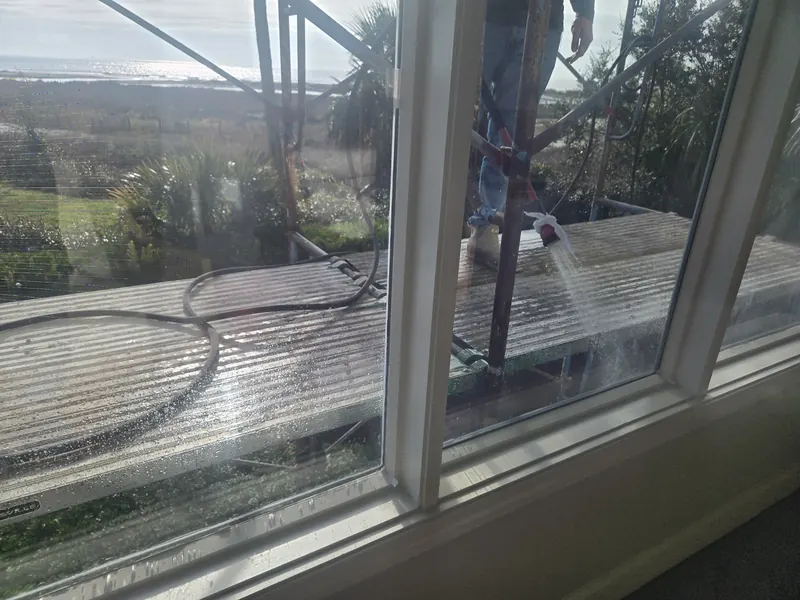
Because the purpose is to reproduce an existing leak, a small amount of water may reach the interior where the unit already leaks, which is why the area is protected first. The test at that location stops when the observer sees water inside.
At sliding glass doors, the crew may build a temporary dam at the sill and fill it with water to test the threshold on its own. That method, and the other common leak points at these doors, are covered in why sliding glass doors leak in Florida condominiums.
If a Wall Needs to Be Opened
When the water path cannot be confirmed from the surface, a small inspection opening shows where water travels inside the wall and which flashing or sealant failed. Openings are kept small and are coordinated with the association in advance. Who patches the opening and restores finishes is set in the proposal before testing begins.
How Long a Water Test Takes
It depends on how many windows, doors, and wall areas are being tested and what access equipment is needed. A single unit with a few suspect openings can often be completed in part of a day. A building-wide program on a high-rise with swing stages or lifts is scheduled over several days. CSI provides the association with a schedule before the test day.
What Happens After the Test
Results go to the association, which decides on repairs and communicates with owners. The engineer reviews the results and is responsible for the conclusions and repair recommendations in the report.
What the Report Includes
The report is written for the board and the manager who must act on it, with enough technical detail for the contractor who will make the repair. It generally includes:
- The leak history reviewed and the theory the testing was designed to prove or rule out.
- A plan of the test locations, keyed to unit numbers and elevations.
- Each test, with the element tested, the method, the duration, and the result.
- Photographs of the setup and of any water observed inside, annotated to show the water path.
- Moisture readings before, during, and after testing.
- The engineer's conclusions on the source of each leak the testing reproduced, and a note of any reported leak that could not be reproduced.
- Repair recommendations.
Repairs and Retesting
CSI can prepare repair specifications for bidding. After repairs, the same tests can be repeated to confirm the repaired element does not leak under the same test conditions. For associations working through a larger exterior repair, CSI's building envelope consulting covers evaluations, repair specifications, and construction oversight.
Test results can also be useful beyond the repair. Under section 718.112(2)(g), Florida Statutes, the structural integrity reserve study required for condominium buildings three habitable stories or higher must include windows and exterior doors, and waterproofing and exterior painting. Water testing is not required for the study, but test results give the engineer direct evidence of how those components are performing.
A Water Test Is Not an Infrared Scan or a Plumbing Search
Owners sometimes expect a water test to look like a thermal camera survey or a plumbing leak search. An infrared scan can help narrow the search but cannot show where water entered the building, and plumbing leak detection looks for leaks in supply lines and drains rather than in exterior walls, windows, and doors. The differences are explained in water testing, leak detection and infrared: what each one does.
Questions about a planned water test can go to CSI through the water intrusion testing page or by phone at (904) 261-8703.
Frequently Asked Questions
Do I need to be home during a condo water test?
Someone needs to be inside the unit during its test, because the interior observer is the person who sees the water arrive. That is usually a CSI team member, with access arranged through the association or the management company. Owners are welcome to be present.
How should I prepare my unit for a water test?
Move furniture, rugs, and stored items away from the windows and doors being tested, take down or tie up blinds, shades, and curtains, relocate electronics and valuables near the test locations, and secure pets. CSI protects the floor at each test location before water is applied.
How long does a water test take?
It depends on how many windows, doors, and wall areas are being tested and what access equipment is needed. A single unit with a few suspect openings can often be completed in part of a day, while a building-wide program on a high-rise with swing stages or lifts is scheduled over several days. CSI provides the association with a schedule before the test day.
Can a water test be done when it is raining?
No. Testing is scheduled for dry weather, because rain wets the exterior and the wall assembly and makes it impossible to tell whether water inside came from the test or from the weather. After heavy rain, walls may need time to dry before moisture readings are reliable.
Will a water test damage my unit?
The test is controlled and observed, and the test at each location stops when the observer sees water inside. A small amount of water may reach the interior where the unit already leaks, which is why the area is protected first. If a wall must be opened, the opening is kept small and coordinated with the association in advance, and who patches it is set in the proposal before testing begins.
Who receives the water test results?
Results go to the association, which decides on repairs and communicates with owners. The report identifies the source of each leak the testing reproduced, notes any reported leak that could not be reproduced, and recommends repairs.
Have a Leak That Keeps Coming Back?
CSI's engineer-led water testing finds where water is entering windows, doors, walls, and balconies, and documents the repair it needs. CSI serves Northeast Florida, coastal Georgia, and Hilton Head, South Carolina.
See How CSI Runs Water TestingSources
- 2026 Florida Statutes, Section 718.111, The association (Florida Senate)
- 2026 Florida Statutes, Section 718.112, Bylaws (Florida Senate)
- Pinpoint the Slab Leak Before You Break the Floor, Contractor Magazine, August 3, 2026
This article is general information. It is not legal advice, and it is not an engineering assessment of any specific building.