

When a leak is reported, a manager may collect proposals for leak detection, an infrared scan, and a water test, and it is not always clear that these are different services. They answer different questions. Choosing the wrong one can produce a report that describes wet drywall in detail without identifying where the water came from.
CSI's guide to water intrusion investigation in Florida buildings explains how infrared, moisture meters, and water testing fit together inside an investigation. This article is about choosing: which tool fits which situation, and what each one can and cannot tell a board.
Start With the Leak History
The first question is when the water appears. A leak that shows up during or after rain, particularly wind-driven rain, points toward the building envelope: the windows, doors, walls, balconies, and roof. A leak that appears in dry weather, runs steadily, or sits below a bathroom or kitchen points toward plumbing or mechanical equipment.
Two simple checks help sort this out. The U.S. Environmental Protection Agency's WaterSense program suggests checking the water meter before and after a two-hour period when no water is being used; if the meter changes at all, there is probably a leak. The EPA also advises keeping air conditioning drip pans clean and drain lines unobstructed and flowing properly, and notes that condensation can collect on cold surfaces such as cold water pipes. The meter check is practical only where a unit has its own meter, and both checks are starting points rather than conclusions.
Plumbing Leak Detection
Plumbing leak detection is a service for finding leaks in pressurized supply lines and drains. Plumbers and leak detection companies use methods such as pressure testing an isolated line and watching for a drop, acoustic equipment that picks up the sound of water escaping under pressure, tracer gas, hydrostatic testing and camera inspection of drain lines, and thermal imaging to find the warm plume from a hot water leak.
These methods are built for piping. They do not apply water to a window or a stucco wall the way rain does, so a clean plumbing report does not rule out an envelope leak, and a plumbing search is the wrong first step for a leak that appears only in storms.
Building Envelope Water Testing
Water testing attempts to reproduce a reported leak under controlled conditions. Water is applied to one window, door, wall, or balcony component at a time while an observer watches the interior. When water appears inside, the test has located a point of entry, which is the information a lasting repair depends on.
CSI's diagnostic testing is based on AAMA 501.2, the nozzle field check written for storefronts, curtain walls, and sloped glazing, which defines the nozzle and gauge setup CSI uses; AAMA 511, FGIA's voluntary guide for the forensic evaluation of water intrusion at windows and doors; and ASTM E1105, the field test method for water penetration under an air pressure difference. The testing team works under the direction of a licensed professional engineer. Testing is scheduled for dry weather, so that water inside can be tied to the test rather than to rain.
Water testing is the tool to use when the leak follows the weather. For what residents should expect in their units, see what to expect during a condo water test. For a closer look at one component, see why sliding glass doors leak in Florida condominiums. The methods and equipment are described on the water intrusion testing page.
Infrared Thermography
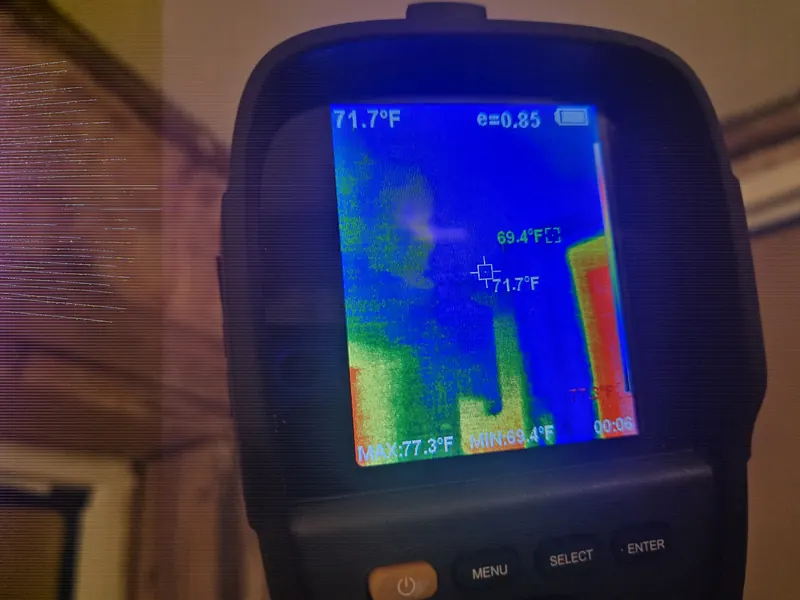
A thermal camera shows temperature differences across a wall or ceiling that can indicate wet materials. It covers a lot of area quickly, which makes it a useful screening tool, but it cannot show where water entered the building. Guidance from a thermal camera manufacturer puts it directly: a thermal imaging camera cannot see moisture in walls, it detects temperature differences that water can cause, and its findings should always be confirmed with a moisture meter.
CSI uses infrared imaging to narrow the search and to follow water once it is inside the building, and confirms infrared findings with a moisture meter before they are reported as moisture. The limits of infrared, including the conditions it needs to be reliable, are covered in the investigation guide linked above. An infrared survey on its own is not enough to design a repair.
Moisture Meters
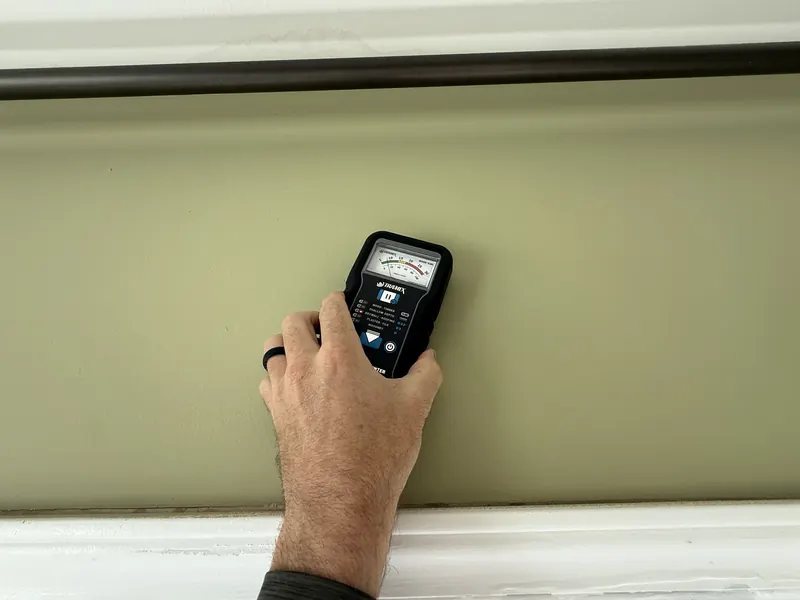
A moisture meter gives a measured reading at an interior wall, sill, or floor. Pin meters measure electrical resistance between two pins pushed into the material, and pinless meters use a sensor pad on the surface. On materials such as drywall, readings are relative: a known dry area of the same material is measured first to establish a baseline, and other areas are compared against it.
That is why a single reading from a single visit says little on its own. Readings taken before, during, and after each water test tie interior moisture to a specific test location instead of relying on a stain that may be months old. A meter can confirm that a wall is wet. It cannot show how the water got there.
Inspection Openings
When the water path cannot be confirmed from the surface, a small inspection opening shows where water travels inside the wall, which flashing or sealant failed, and how much damage the framing, sheathing, or block has sustained. Openings are kept small and coordinated with the association in advance, and who patches the opening and restores finishes is set in the proposal before testing begins. An opening is a confirmation step, made after testing has narrowed the location, not a substitute for testing.
Which One Does the Board Need?
- Water appears in dry weather, the meter moves with all water off, or the stain is near plumbing fixtures. Start with a plumber or a plumbing leak detection service.
- Water appears near the air conditioning equipment or its drain line. Have the condensate drip pan and drain line checked.
- Water appears with rain, especially wind-driven rain. Start with an engineer's review of the leak history and building envelope water testing, with infrared imaging and moisture meters as supporting tools.
- The source is known and the board needs to know how far the water has spread. Use infrared imaging and moisture readings, with inspection openings where needed.
- Windows or doors are being replaced. Write field testing of installed units into the specifications. CSI's window and door replacement specifications require field testing based on ASTM E1105 and require units that fail to be corrected and retested.
- The cause is unclear. Start with the leak history. A review by an engineer can help rule the building envelope in or out before money is spent on testing.
Water test results can also support longer-term planning. Under section 718.112(2)(g), Florida Statutes, the structural integrity reserve study required for condominium buildings three habitable stories or higher must include windows and exterior doors, and waterproofing and exterior painting. Water testing is not required for the study, but test results give the engineer direct evidence of how those components are performing, which supports the remaining useful life and cost estimates. Associations working through a larger envelope repair can find more on evaluations, repair specifications, and construction oversight on CSI's building envelope consulting page.
To discuss which approach fits a leak at your building, see the water intrusion testing page or call CSI at (904) 261-8703.
Frequently Asked Questions
Is an infrared scan enough to find a leak?
No. Infrared thermography shows temperature differences that may indicate wet materials, which makes it a useful screening tool, but it cannot show where water entered the building. Infrared findings should be confirmed with a moisture meter, and controlled water testing is what locates the point of entry.
What is the difference between plumbing leak detection and water testing?
Plumbing leak detection finds leaks in pressurized supply lines and drains, using methods such as pressure testing, acoustic equipment, tracer gas, and drain cameras. Building envelope water testing applies water to one window, door, wall, or balcony component at a time to reproduce a rain leak and locate where water enters the building.
How can a board tell whether a leak comes from plumbing or from rain?
Start with when the water appears. Leaks during or after rain point toward the building envelope, while leaks in dry weather or below bathrooms and kitchens point toward plumbing or mechanical equipment. The EPA suggests checking the water meter before and after a two-hour period with no water in use; if it changes, there is probably a leak.
What does a moisture meter tell you?
A moisture meter confirms whether a material is wet. On materials such as drywall the readings are relative, so they are compared against a known dry area. Readings taken before, during, and after a water test tie moisture to a specific test location, but a meter cannot show how the water got there.
When is an inspection opening needed?
When the water path cannot be confirmed from the surface. A small opening shows where water travels inside the wall, which flashing or sealant failed, and how much damage has occurred. Openings are kept small, coordinated with the association in advance, and who patches them is set in the proposal before testing begins.
Have a Leak That Keeps Coming Back?
CSI's engineer-led water testing finds where water is entering windows, doors, walls, and balconies, and documents the repair it needs. CSI serves Northeast Florida, coastal Georgia, and Hilton Head, South Carolina.
See How CSI Runs Water TestingSources
- Fix a Leak Week, U.S. Environmental Protection Agency WaterSense
- A Brief Guide to Mold, Moisture, and Your Home, U.S. Environmental Protection Agency
- Pinpoint the Slab Leak Before You Break the Floor, Contractor Magazine, August 3, 2026
- How to Detect a Water Leak with Thermal Imaging, Teledyne FLIR, October 4, 2019
- Differences Between Pin vs Pinless Moisture Meters, Wagner Meters
- 2026 Florida Statutes, Section 718.112, Bylaws (Florida Senate)
This article is general information. It is not legal advice, and it is not an engineering assessment of any specific building.